Skip to content

DeepSeek V3.2-Exp Cuts Long-Context Costs with DeepSeek Sparse Attention (DSA) While Maintaining Benchmark Parity Asif Razzaq Artificial Intelligence Category – MarkTechPost

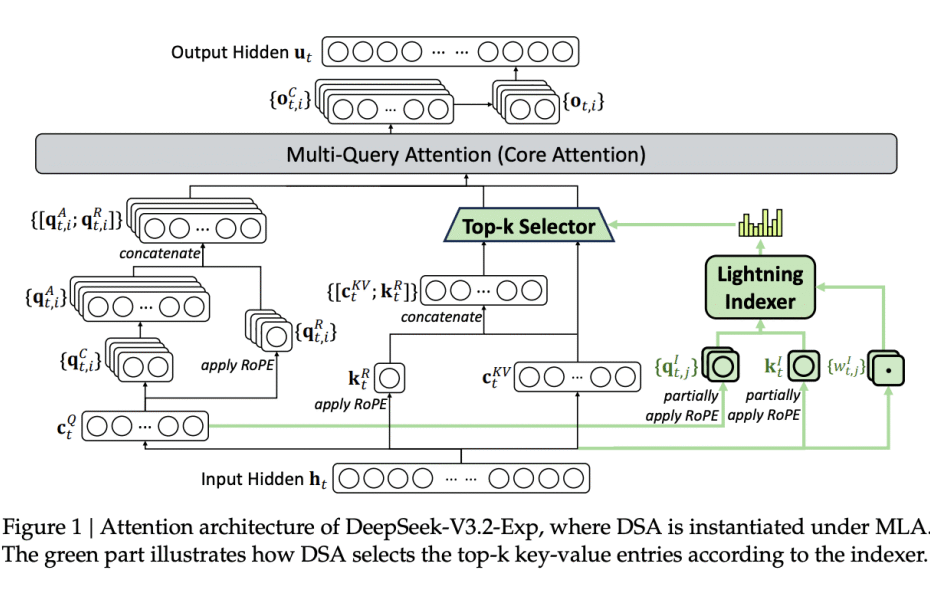
​[[{“value”:” Table of contents FP8 index → top-k selection → sparse core attention Lets Talk about it’s efficiency and accuracy Summary FAQs DeepSeek released DeepSeek-V3.2-Exp, an “intermediate” update to V3.1 that adds DeepSeek Sparse Attention (DSA)—a trainable sparsification path aimed at long-context efficiency. DeepSeek also… Read More »DeepSeek V3.2-Exp Cuts Long-Context Costs with DeepSeek Sparse Attention (DSA) While Maintaining Benchmark Parity Asif Razzaq Artificial Intelligence Category – MarkTechPost

Meet oLLM: A Lightweight Python Library that brings 100K-Context LLM Inference to 8 GB Consumer GPUs via SSD Offload—No Quantization Required Asif Razzaq Artificial Intelligence Category – MarkTechPost

​[[{“value”:” oLLM is a lightweight Python library built on top of Huggingface Transformers and PyTorch and runs large-context Transformers on NVIDIA GPUs by aggressively offloading weights and KV-cache to fast local SSDs. The project targets offline, single-GPU workloads and explicitly avoids quantization, using FP16/BF16 weights… Read More »Meet oLLM: A Lightweight Python Library that brings 100K-Context LLM Inference to 8 GB Consumer GPUs via SSD Offload—No Quantization Required Asif Razzaq Artificial Intelligence Category – MarkTechPost

7 Python Decorator Tricks to Write Cleaner Code Iván Palomares Carrascosa MachineLearningMastery.com

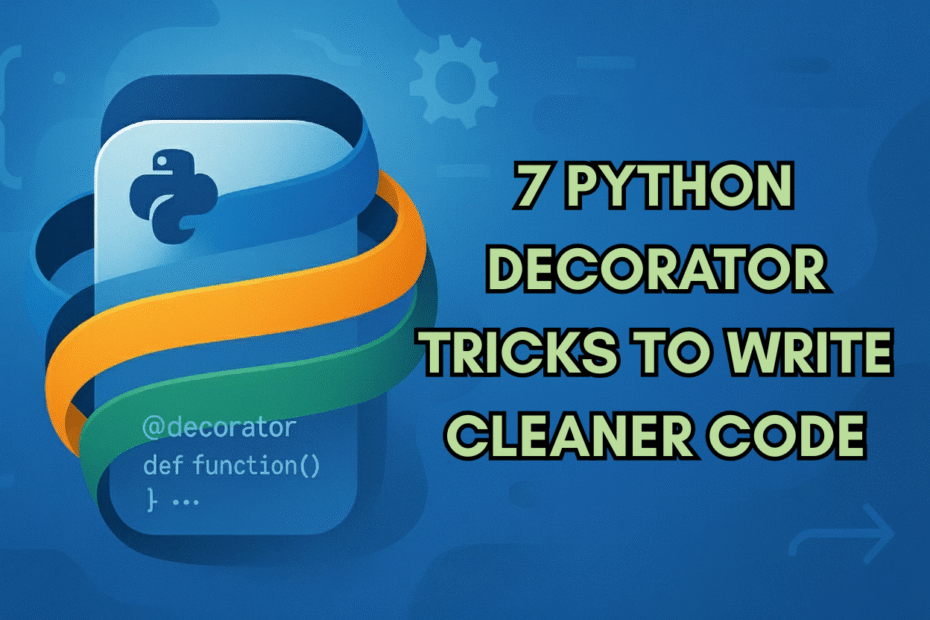
​Usually shrouded in mystery at first glance, Python decorators are, at their core, functions wrapped around other functions to provide extra functionality without altering the key logic in the function being “decorated”. Usually shrouded in mystery at first glance, Python decorators are, at their core, functions… Read More »7 Python Decorator Tricks to Write Cleaner Code Iván Palomares Carrascosa MachineLearningMastery.com

Flow State to Free Fall: An AI Coding Cautionary Tale Sreeram Venkatasubramanian AI & ML – Radar

​[[{“value”:” When I was eight years old, I watched a mountaineering documentary while waiting for the cricket match to start. I remember being incredibly frustrated watching these climbers inch their way up a massive rock face, stopping every few feet to hammer what looked like… Read More »Flow State to Free Fall: An AI Coding Cautionary Tale Sreeram Venkatasubramanian AI & ML – Radar

Generative and Contrastive Graph Representation Learning Apple Machine Learning Research

​Self-supervised learning (SSL) on graphs generates node and graph representations (i.e., embeddings) that can be used for downstream tasks such as node classification, node clustering, and link prediction. Graph SSL is particularly useful in scenarios with limited or no labeled data. Existing SSL methods predominantly… Read More »Generative and Contrastive Graph Representation Learning Apple Machine Learning Research

PREAMBLE: Private and Efficient Aggregation via Block Sparse Vectors Apple Machine Learning Research

​[[{“value”:”We revisit the problem of secure aggregation of high-dimensional vectors in a two-server system such as Prio. These systems are typically used to aggregate vectors such as gradients in private federated learning, where the aggregate itself is protected via noise addition to ensure differential privacy.… Read More »PREAMBLE: Private and Efficient Aggregation via Block Sparse Vectors Apple Machine Learning Research

Enabling Differentially Private Federated Learning for Speech Recognition: Benchmarks, Adaptive Optimizers, and Gradient Clipping Apple Machine Learning Research

​While federated learning (FL) and differential privacy (DP) have been extensively studied, their application to automatic speech recognition (ASR) remains largely unexplored due to the challenges in training large transformer models. Specifically, large models further exacerbate issues in FL as they are particularly susceptible to… Read More »Enabling Differentially Private Federated Learning for Speech Recognition: Benchmarks, Adaptive Optimizers, and Gradient Clipping Apple Machine Learning Research

The Illusion of Thinking: Understanding the Strengths and Limitations of Reasoning Models via the Lens of Problem Complexity Apple Machine Learning Research

​Recent generations of frontier language models have introduced Large Reasoning Models (LRMs) that generate detailed thinking processes before providing answers. While these models demonstrate improved performance on reasoning benchmarks, their fundamental capabilities, scaling properties, and limitations remain insufficiently understood. Current evaluations primarily focus on established… Read More »The Illusion of Thinking: Understanding the Strengths and Limitations of Reasoning Models via the Lens of Problem Complexity Apple Machine Learning Research